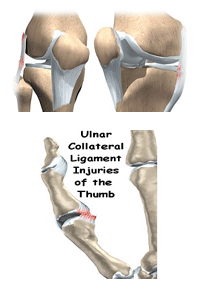
| Ligament
injuries They study of ligaments are known as Desmology.
Ligaments are a strong band of white fibrous connective tissue
composed mainly of long, stringy collagen fibres joins bones
to other bones or to cartilage in the joints. They played
the main role in the stability of the joint (because the main
characteristic of ligaments is like elastic, it will gradually
lengthen when under tension- muscle contraction & relaxation
or joint distraction & compression) and the freedom of
movement within a certain range.
A sprain is damage to or tearing of ligaments or the capsules,
when excessive forces like joint twist or abnormal joint mobility
leads to torn or damage the ligaments that hold the bones
together, results in ligament sprain. The common sites are
the ankle and knee joints in the lower limb, wrist and finger
joints are in the upper lime. When excessive force is applied
to a joint, the ligaments that hold the bones together may
be torn or damaged. This action results in a sprain, and its
seriousness depends on how badly the ligaments are torn. Any
joint can be sprained, but the most frequently injured joints
are the ankle, knee, and finger. The knee joint (major weight
bearing joint in the body) is a vulnerable joint in the body
gets injured very easily and frequently. Ligament injuries
are usually graded depends on their severity. Grade I, Grade
II and Grade III.
Symptoms of a ligament injury are:
severe pain at the time of the injury
feel or hear a pop or tear inside the joint
immediate swelling and bruising at the joint and
instability and giving way of the joint after injury.
In the current medical field, a wide variety of Physiotherapy
modalities are available in management of ligament injuries.
Treatment includes:
*Pain and swelling relieve techniques *Hands on techniques
like manipulation, mobilization and therapeutic massage, Therapeutic
exercise and training in ADL.
|